How Does Dry Cleaning Actually Work?
Dry cleaning is not dry, and the machine is not what removes your stains. Here is what actually happens to your garment between drop-off and pickup.
The Name Is Misleading: Dry Cleaning Is Not Dry
Dry cleaning uses liquid. What it does not use is water, and that single difference is the entire point. Take wool. Every wool fiber is covered in overlapping scales, like shingles on a roof. Add water, heat, and agitation and those scales swell, lift, and ratchet past each other until they lock together permanently. Textile scientists call it felting, and it is why a wool sweater comes out of a hot wash sized for a child. It cannot be undone. Silk has a related problem, because water weakens the hydrogen bonds that hold its protein structure together, and rayon actually loses strength while it is wet, so agitating it saturated can distort the weave for good. Dry cleaning sidesteps all of this by replacing water with a solvent that dissolves oils and soils without ever swelling the fiber. The word dry means water-free, not liquid-free.
Step 1: Inspection and Tagging
Every garment is examined by hand before it goes near a machine. We tag it so it cannot be separated from your order, read the care label and fiber content, empty the pockets, and note every stain, loose button, weak seam, and existing flaw. This step matters more than it sounds, because the correct treatment for a wine stain and the correct treatment for a grease stain are chemically opposite. A cleaner who does not identify a stain before treating it is guessing, and guessing on silk is how garments get ruined.
Step 2: Pre-Spotting, Where Stains Are Actually Removed
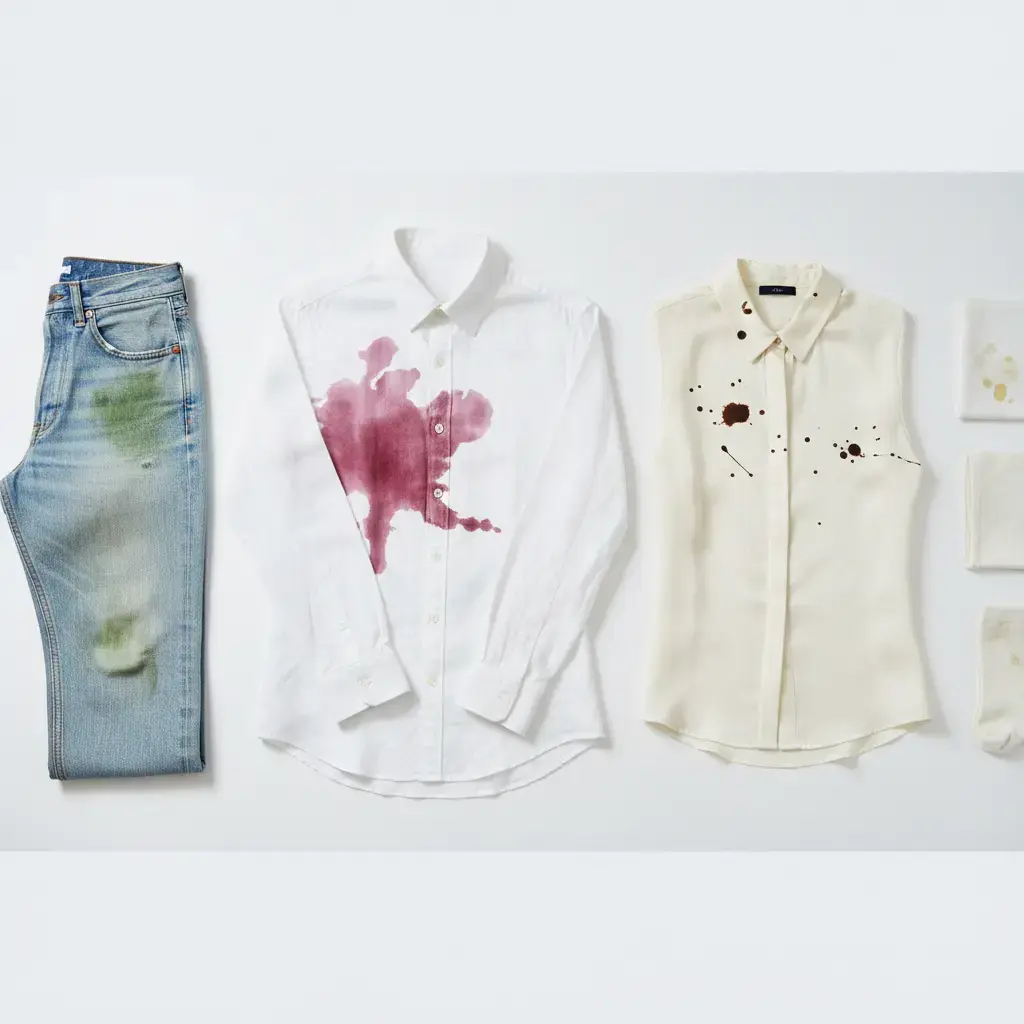
Here is the part most people get wrong: the machine does not remove your stains. A trained spotter does, by hand, before the garment is ever cleaned. Working at a spotting board with steam, a vacuum, and a range of specific agents, the spotter treats each mark according to what it is. Tannin stains like wine and coffee need acidic chemistry. Protein stains like blood and perspiration need enzyme-based agents that break the proteins down. Oil and grease need solvent. These formulas are not interchangeable, and using the wrong one first can lock a stain in permanently. This is the single biggest difference between a careful cleaner and a cheap one, and it is completely invisible on your receipt.
Step 3: The Cleaning Cycle
The garment then goes into a machine that looks like a large front-loading washer and works nothing like one. It gently circulates solvent through the fabric, lifting out body oils and general soil, then extracts the solvent and tumbles the garment in warm air to evaporate what remains. The solvent is continuously filtered and distilled, so garments are cleaned in clear solvent rather than in the residue of the load before them. The cycle is gentle by design, because the pre-spotting already did the difficult work.
A Note on Solvents, Because You Should Know This
For decades the industry ran on perchloroethylene, known as PERC, which is classified as a likely human carcinogen and is the source of that sharp chemical smell on clothes from a conventional cleaner. The EPA finalized a national phase-out in December 2024. We do not use it. Our process is organic and PERC-free, which is gentler on fibers, hypoallergenic, and safe for sensitive skin, and your clothes come back without that harsh chemical odor. If you have ever hung a freshly cleaned suit in a small closet and gotten a headache from it, you already know what the difference feels like.
Step 4: Post-Spotting and Finishing
After cleaning, every garment is inspected again under focused light. If a mark survived, it goes back to the spotting board for a second, more targeted treatment. Then comes finishing, which is where a garment stops looking clean and starts looking new. Steam relaxes the fibers, and hand pressing rebuilds the structure the tailor originally built in: the roll of a lapel, the crease of a trouser, the drape of a shoulder. Machine pressing is fast. Hand finishing is what makes a suit look like it belongs to someone who cares, and it is the step budget shops cut first to hit a low headline price.
Step 5: Final Inspection
The garment is checked one last time against the notes taken at intake, buttons and seams are confirmed, and it is bagged. Turnaround for most garments is 24 to 48 hours, a little longer for suits and considerably longer for wedding gowns, which are almost entirely hand work. If a stain did not come out, you should be told at pickup, not left to discover it at home.
What Dry Cleaning Cannot Do
Dry cleaning excels at oil and grease, body soils, makeup, and general wear, and it protects the structure and color of wool, silk, cashmere, and tailored pieces. What it cannot do is undo damage. A stain that has been through a hot dryer or under an iron has been heat-set, meaning heat has chemically bonded it to the fiber, and no amount of skill reliably reverses that. Dye that has already been stripped by bleach cannot be put back. Fibers worn through cannot be restored. This is why timing beats technique. A fresh stain is a cleaning problem. A stain that sat in a warm closet for a season is often a permanent one. Any cleaner who promises to remove every stain from every fabric is telling you what you want to hear. What we will tell you instead is this: the overwhelming majority of stains that reach us within a few days of happening come out completely. The ones that do not are almost always the ones that sat in a closet for a season first. So if you are looking at a stained garment right now, wondering whether it is worth bringing in, the answer is yes, and today is worth more than next month.
Now that you know how much of dry cleaning is hand work rather than machine work, you know what to actually look for in a cleaner. Baroni Cleaners has been doing that hand work in Irvine since 1985, with organic PERC-free solvent, hand spotting and hand finishing on every garment, and honest answers about what will and will not come out. Free pickup and delivery throughout Irvine, Newport Beach, Tustin, and Santa Ana. Call (949) 316-4276 or schedule at baronicleaners.com.
Frequently Asked Questions
Related Services
Need Professional Garment Care?
Schedule a free pickup today. Organic cleaning, 48-hour turnaround, always free delivery.